
Barcelona - What to See
Barcelona is a city full of history. It's no wonder it attracts so many tourists, not only from Poland but from all over Europe. In addition to modern, vibrant architecture, Barcelona has many, one could say, abstract structures from the times of Antoni Gaudí, who amazed with his creative and unconventional designs. In Barcelona, you have access to various attractions from visiting magnificent museums, through wandering the Spanish streets among modern and historical buildings, to beach lounging or tasting Spanish relaxation in gastronomic venues. In this article, we will guide you through the Catalan capital and present many places worth visiting when in Barcelona.
If you're going to Barcelona and wondering how to plan other aspects of your trip regarding transport, tickets, etc., check out our Barcelona guide, where we describe all these elements in detail!
Barcelona - transport: airports, metro, tickets and travel cards
We have prepared a practical guide for you on attractions, tickets, districts, and local delicacies. Perfect for the first time and beyond.
Table of contents:
Barcelona
It is one of the most frequently visited cities in Europe, and not without reason. It has as many as 9 sites inscribed on the UNESCO World Heritage List, including works by Gaudí, such as Sagrada Família, Park Güell and Casa Batlló. But that's just the beginning because Barcelona also means neighborhoods with soul, local markets, life happening in squares and streets that encourage walking. Barcelona is also a sports center and home to the FC Barcelona football club with the iconic Camp Nou stadium, as well as an athletics stadium where the Olympic Games were held and a huge Olympic torch was lit.
From the east, Barcelona borders the beach and port, and from the west with green mountain areas, the highest point of which is Tibidabo hill. Barcelona is a tourist-friendly region all year round, but it's best to visit in spring (March - May) or autumn (September - October), when it's warm but not crowded. However, these are rarely good periods for beach activities. If you want to take advantage of sea activities, summer can be a good period - hot, but full of tourists. Winter, on the other hand, is mild here.
What to See
Map
To make it easier for you to plan your time, we leave you a map with attractions described below in the article.
Sagrada Familia
One of the most popular symbols of Barcelona and the greatest work of the famous Spanish architect Antoni Gaudí. We will mention him many more times in this article, because the designer left behind many wonderful projects and structures that now constitute Barcelona's landmarks.
Antoni Gaudi (1852 - 1926) - Spanish architect who became famous for his unique and original designs. He was the main representative of Catalan Art Nouveau, although his style quickly went beyond any rigid framework. During his lifetime, Antoni Gaudí was a controversial figure and not always understood. His projects aroused admiration in some and incomprehension in others. For some he was a visionary, for others an eccentric with an obsession with detail. At the end of the 19th century, the style of Catalan modernism dominated - ornate, rich, with influences of Gothic and Art Nouveau. Gaudi came from this movement, but quickly began to create his own architectural language that was difficult to categorize. He was inspired by nature, geometry, religion and crafts. Now his works are easily recognizable and particularly stand out against contemporary architecture: undulating lines, organic shapes, colorful mosaics, nature-inspired forms. Today, most of his works are icons of Barcelona and monuments inscribed on the UNESCO list. The most famous include Sagrada Família, Park Güell, Casa Batlló or La Pedrera. Gaudi died tragically in 1926, hit by a tram, but his vision still shapes the image of the city today.
Sagrada Família is located in the Eixample district, at Carrer de Mallorca 401. The most convenient way to get there is by metro (lines L2 and L5) to Sagrada Familia station.
It's not without reason that Sagrada Familia is one of the most recognizable structures in Europe and maybe even in the world. Its style catches the eye and the construction, symbolism, amount of detail, really arouse admiration. It is a work inscribed on the UNESCO World Heritage List. Construction began in 1882 and continues to this day. The work is to be completed in 2026, exactly on the hundredth anniversary of its architect's death. Gaudi devoted as many as 40 years of his life to this project, and after his death he was buried there. All elements of the basilica have deep symbolism, which is best seen by buying a ticket to visit it. Sagrada already makes a huge impression from the outside and catches the eye, but it's even better to admire it up close and inside. Even with the basic ticket, you have the opportunity to use an audio guide, also available in Polish. This is especially necessary to understand the history of this structure and the symbolism of individual elements. Looking at the sculptures and decorations, we can see what inspired the artist - religion and nature. Each part of the structure has a specific meaning and reference to religious events. It is unique on a global scale not only architecturally, but also spiritually. Regardless of whether you're interested in architecture or not, in our opinion it's really worth seeing!
Tickets
It's best to buy online on Sagrada's official website - link to website https://sagradafamilia.org/, with a choice of day and time. Tickets sell out in advance, so it's not worth waiting until the last minute. Avoid buying tickets on site because queues can be long and availability limited. Ticket options:
Sagrada Familia Visit - 26€, includes:
Entrance to Sagrada Familia
Access to the official app
Audio guide to download via the app - own headphones required
Guided Tour of Sagrada Familia - 30€, includes:
Entrance to Sagrada Familia
Access to the official app
Guide
Audio guide to download via the app
Sagrada Familia Visit with Tower - 36€, includes:
Entrance to Sagrada Familia
Access to the official app
Entrance to one of Sagrada's towers
Audio guide to download via the app - own headphones required
Guided Tour of Sagrada Familia with Tower - 40€, includes:
Entrance to Sagrada Familia
Access to the official app
Entrance to one of Sagrada's towers
Guide
Audio guide to download via the app
It's important to arrive on time, especially if you choose the guided tour option. Before entering the cathedral, you must go through security check. Choosing the audio guide option, you can discover the symbolism of individual parts and elements of Sagrada at your own pace. Available in many languages, also in Polish. The audio guide time is about an hour, but it's worth giving yourself more time for free exploration. The guided tour time is about 1:30 hours.
What time is best for visiting Sagrada?
It's best to come in the morning or late afternoon, when light enters through the stained glass windows and creates an amazing atmosphere inside. Each part of the cathedral has its own symbolism and colors also play a huge role here. That's why it's worth paying attention to the weather forecast and going on a sunny day. Avoid visits at noon (most people) and on weekends during the season, because it's crowded and noisy.
Park Güell
Park Güell is one of the most recognizable and unique places in Barcelona, being a showcase of Antoni Gaudí's creativity. The park is located in the northern part of the city, on the hills of the Gràcia district, from where there is a beautiful view of Barcelona and the Mediterranean Sea. It's an ideal place to combine sightseeing, architecture and a moment of respite from the urban hustle and bustle.
The author of the project is of course Antoni Gaudí, and the park itself was created at the beginning of the 20th century commissioned by Eusebi Güell - a wealthy industrialist and patron of the arts. Originally, this place was to be a luxury residential estate inspired by the 'garden city' idea, but the project was not commercially successful. Ultimately, the area was transformed into a city park, which today is on the UNESCO World Heritage List.
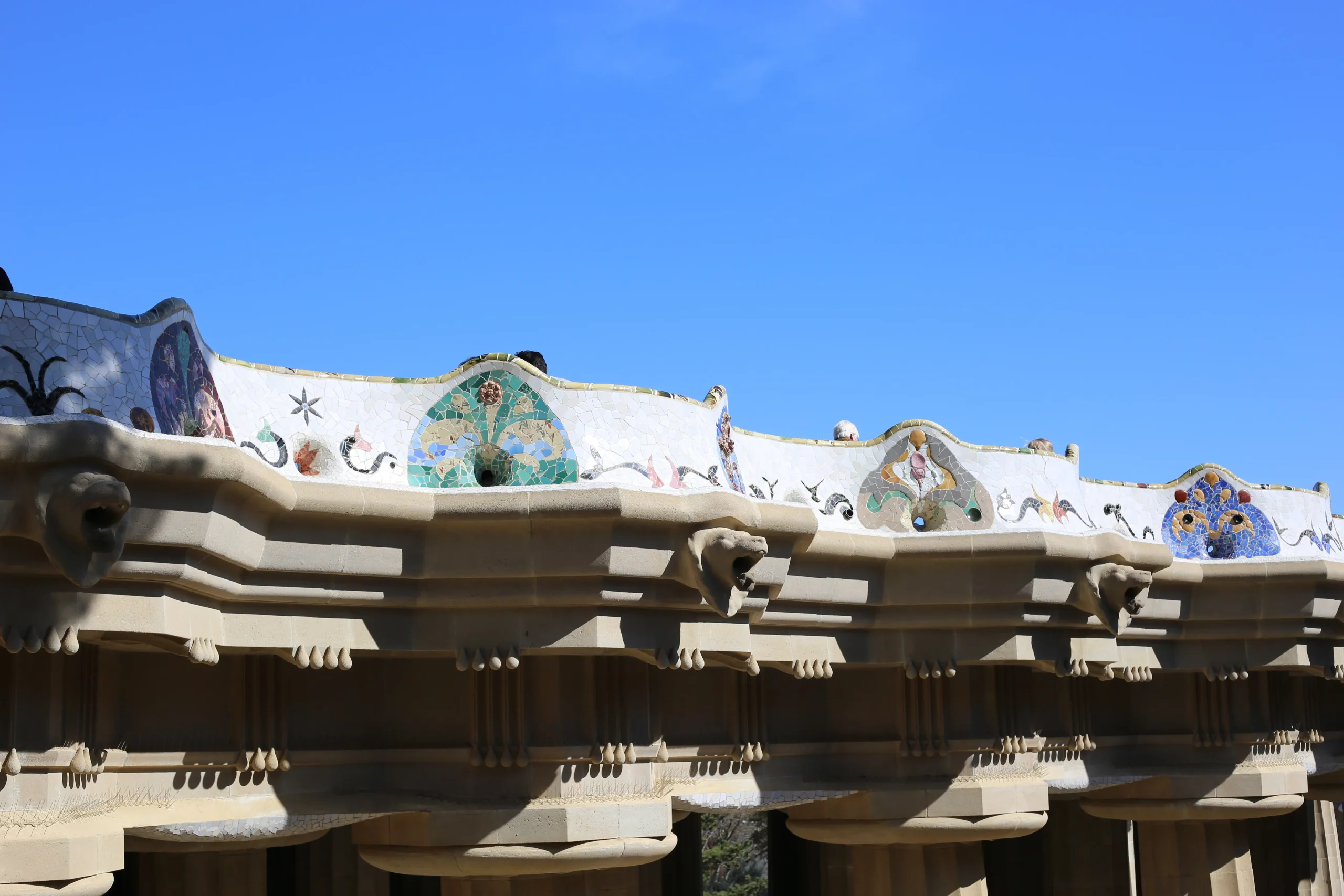
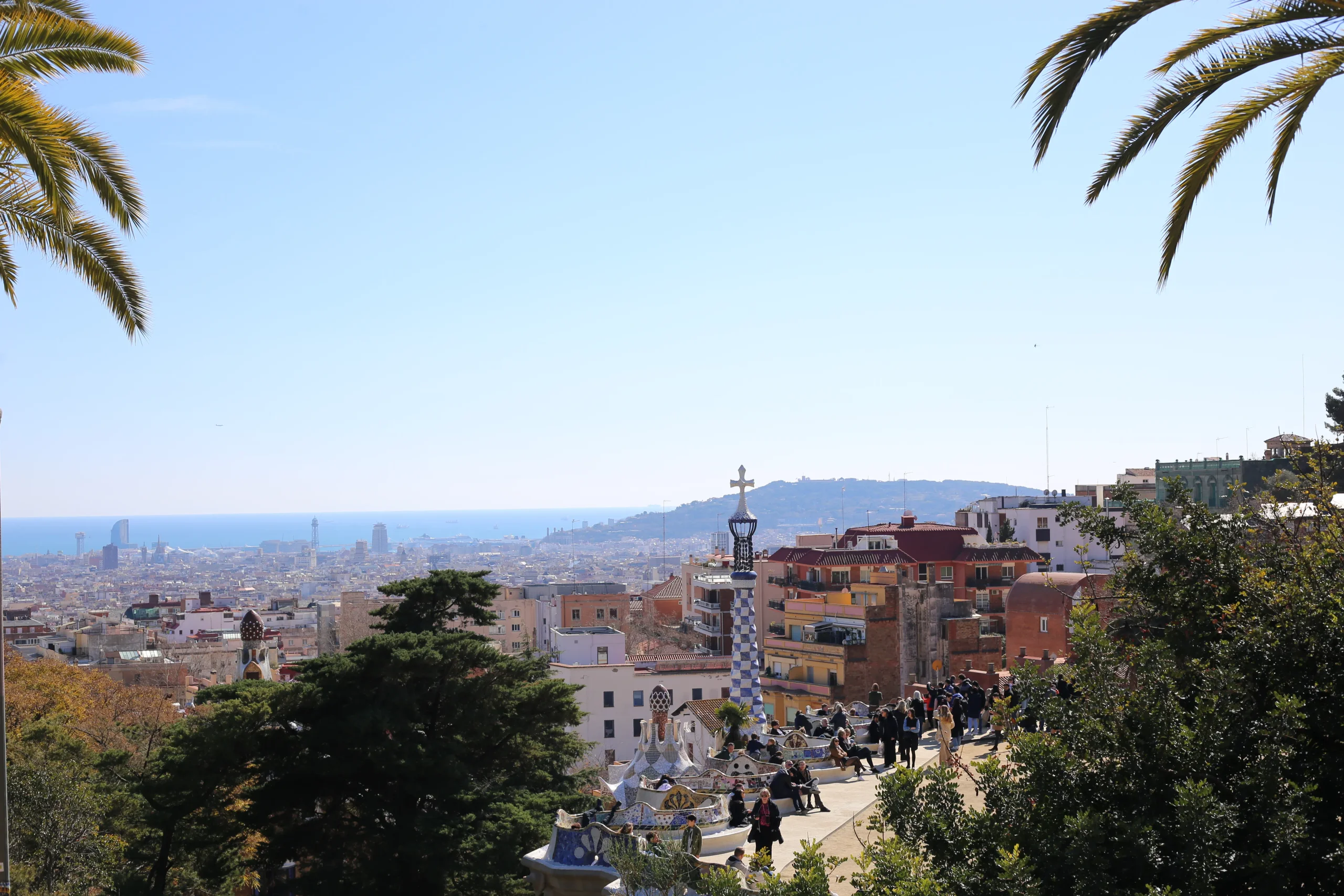
Park Güell covers an area of about 17 hectares and consists of two parts: a publicly accessible, green zone and a monumental zone, for which entrance tickets apply. It is in this ticketed part that the park's most characteristic elements are located, such as the famous colorful salamander (El Drac), winding entrance stairs, Hall of Hundred Columns, undulating bench covered with azulejo mosaic and a viewing terrace with a panorama of the city.
Bench with mosaic
Stairs at the main entrance
View of the terrace
View from the terrace
Colorful salamander
Secondary viewpoint
What distinguishes Park Güell is the extraordinary combination of architecture with nature. Gaudí designed the space to perfectly harmonize with the terrain - columns resemble tree trunks, paths were adapted to hillsides. The whole creates a fairy-tale, almost surrealistic landscape that's hard to compare with any other park in Europe.
Park Güell is a place that will delight both architecture lovers and people looking for beautiful views and a peaceful space to relax. It's one of those Barcelona attractions that definitely cannot be missed, regardless of whether you're visiting the city for the first time or returning here again.
Tickets
The price of a regular entrance ticket is 18 €, discounts are also available for children, seniors and Barcelona residents. You can also visit the park with a guide. Current prices and opening hours are best checked on the park's official website - link to website https://parkguell.barcelona/. Important information for visitors:
To not lose entry, you must report to the access control point at the time indicated on the ticket. Outside the times indicated on the ticket, entry will not be possible. You have a 30-minute grace period from the time indicated on the ticket to enter the site. After this period expires, you lose the right to entry.
Once you're in the park, there's no time limit, you can admire the work of the brilliant architect for as long as you want, but after leaving there will be no possibility of re-entry.
It's best to buy entrance tickets online a few days in advance, especially in season, because the number of entries is limited.
Museu Nacional d'Art de Catalunya
Museu Nacional d'Art de Catalunya (MNAC) is one of the most important museums in Barcelona and at the same time one of the more impressive places in terms of location. It is located on Montjuïc hill, in the monumental Palau Nacional building, which was erected for the World Exhibition in 1929. The museum building itself makes a huge impression, both up close and from a distance, and is one of the most recognizable points of the city's panorama.
MNAC is famous primarily for the world's largest collection of Romanesque art, including priceless frescoes transferred from Pyrenean churches. In addition, the museum can see rich collections of Gothic, Renaissance, Baroque art and modern works. Even if you're not big museum fans, it's worth visiting here even for the interior architecture itself and the viewing terrace, from which there is a beautiful panorama of Barcelona - on Plaza de España, fountains and the rest of the city.
In front of the museum are the famous Montjuïc Fountains (Font Màgica), which in the evenings turn into spectacular shows of light, music and water. It's a very atmospheric place in Barcelona, especially after dark, when the stairs leading to MNAC are beautifully lit and full of strolling people.
Right at the foot of the hill is Arena Mall (Las Arenas de Barcelona) a modern shopping center located in a restored, former bullfighting arena. It's an interesting example of adapting a historic building to contemporary functions. On the roof of the Arena there is a viewing terrace with restaurants, from which you can also admire Plaza de España and Montjuïc from a different perspective.
Plaza de España from Arena Mall roof
Within walking distance from MNAC, it's also worth visiting Jardí Botànic Històric, a historic botanical garden hidden in the natural depressions of the Montjuïc terrain. It is a much quieter and less frequented place than the main attractions of the hill. Thanks to the specific microclimate, plants characteristic of wetter regions grow here, which is an interesting contrast to Barcelona's dry climate. It's an ideal space for a moment of rest in the shade of greenery, away from crowds of tourists. A bit further is the stadium (Estadi Olimpic Lluis Companys), where the Summer Olympic Games were held in 1992, symbolized by a tall, visible from afar Olympic torch. Around it is a whole sports complex.
Garden - Jardí Botànic Històric
Olympic torch at Estadi Olimpic Lluis Companys
The entire Montjuïc area, with MNAC as the central point, is an excellent place for a several-hour walk combining culture, architecture, views and relaxation. It's definitely worth reserving more time for this region of Barcelona, because it offers much more than just one museum. You can get here without problems by metro by getting off at Espanya.
Casa Batlló, Casa Milà and Casa Vincens Gaudi
Barcelona wouldn't be Barcelona without further works by Antoni Gaudí, and three of his residential house designs are among the next most characteristic monuments of the city.
Casa Batlló is a true pearl of modernism, located on the representative Passeig de Gràcia. The building captivates with its undulating facade, colorful mosaic and organic shapes inspired by nature. The roof resembling a dragon's ridge and unusual architectural details make Casa Batlló one of the most photographed places in Barcelona. The interior can be visited, and the interactive exhibition form allows you to better understand Gaudí's vision. Ticket prices start from 25 € and are available on the website - link to website https://casabatllo.es.
A few hundred meters away is Casa Milà, also known as La Pedrera. This is another iconic Gaudí building, which stands out with its massive, undulating form and characteristic chimneys on the roof. The roof of La Pedrera is a real work of art - full of sculptural forms and viewpoints over the city. The building can be visited in part, the rest still serves a residential function. Entrance prices start from 25 € and can be purchased on the official website - link to website https://lapedrera.com
Somewhat different from the others, but equally unique is Casa Vicens. Located in the Gràcia district, it differs stylistically from his later realizations. Geometric forms, intense colors and oriental inspirations dominate here. The interior is equally unique and can be visited independently or with a guide. Basic prices start from 22 € and can be purchased on the website link to website https://casavicens.org
If you plan to visit more than one building inside, it's worth buying a combined ticket or using one of the cards mentioned above. All these buildings have been inscribed on the UNESCO World Heritage List.
Parc de la Ciutadella
For a moment of respite between intensive sightseeing, it's worth stopping at Parc de la Ciutadella, one of Barcelona's most beautiful and popular parks. It's an ideal place for a short walk, rest in the shade of trees or a picnic with a view of historic architecture. The park is crossed by numerous alleys leading between palm trees, exotic vegetation and well-kept lawns. The most characteristic point is the monumental fountain - richly decorated and inspired by Roman waterfalls, at which tourists and residents often gather. In the central part of the park there is a small lake where you can take a boat ride, and in the further part stretches Zoo de Barcelona, one of the largest zoos in Spain. Parc de la Ciutadella is a place full of life - you'll often meet street artists, musicians and residents relaxing after work. It's an excellent stop before further exploration of the El Born district or a walk towards the beach.
Tibidabo
Visible from practically every point in Barcelona, Tibidabo hill is one of the city's most characteristic places. On its top stands the monumental Church of the Sacred Heart of Jesus (Temple Expiatori del Sagrat Cor), crowned with a figure of Christ with outstretched arms, which towers over all of Barcelona. Right next to it is also one of the oldest amusement parks in Europe - Parc d'Atraccions Tibidabo, with a characteristic Ferris wheel that fits perfectly into the panorama of the hill. At the top, the Torre de Collserola radio and television tower is also visible. From Tibidabo there is a spectacular view of the entire city and the Mediterranean Sea, making this place one of the best viewpoints in Barcelona. It's also an excellent location for admiring the sunset, when the city takes on golden and pink hues.
You can get to Tibidabo by the cable car-funicular Funicular del Tibidabo, and then there are about 2 km left to the very top. This section can be walked quite steeply uphill, or you can take bus number 111, whose stop is right at the exit from the funicular. Tibidabo is a point that's definitely worth including in your Barcelona sightseeing plan!
Barri Gòtic
This is the oldest part of Barcelona in its main part hiding many attractions. First of all, the most popular street in Barcelona - La Rambla, starting at the main Plaça de Catalunya, an important metro, bus and main street hub, and leading in a straight line to the port itself at the Christopher Columbus monument. A street that every tourist will walk at least once in their journey, full of artists, dancers or mimes. Along it stretch rows of shops, bars and restaurants. However, as you can guess, prices there are among the highest. In the crowd there are also pickpockets, so you should be extremely vigilant there. Interesting points on this street include the characteristic Liceu Theatre, as well as La Boqueria, an extensive market with a diverse assortment from fish to fresh fruit or sweets. The market attracts many tourists, but prices are also touristy. If you're looking for local specialties at a good price, we would recommend looking for something outside the center. However, you should go to La Boqueria for a walk. From La Rambla it's worth going deeper into the Barri Gòtic district and approaching the characteristic bridge between buildings with many decorations -Pont del Bisbe. Right next to it is Plaça de Sant Jaume, surrounded by two buildings built in Gothic style and now serving government functions: the seat of the Government of Catalonia (Palau de la Generalitat de Catalunya) and the seat of the Barcelona City Council (Ajuntament de Barcelona). This square has enormous historical significance, and today manifestations and cultural events often take place here.
Cathedral of St. Eulalia
Going further from Plaça de Sant Jaume, through the previously mentioned passage under Pont del Bisbe we quickly reach another Square - Plaça Nova. There the imposing Cathedral of St. Eulalia appears before us (unfortunately during our stay under renovation and with a huge advertisement). This is Barcelona's main cathedral and one of the most important Gothic monuments in the entire city. It was built from the 13th to 15th century on the site of a former Roman temple, and owes its name to St. Eulalia - a young martyr who according to legend was tortured for her faith in Roman times.
Entry to the interior of the cathedral is available for people who want to pray and for masses. For tourists, entry is possible for a fee, thanks to which you can visit not only the interior of the temple and crypts, but also the museum and the cathedral roof (which we especially recommend). And what does the Cathedral hide? First of all, the cathedral captivates with its monumental facade, pointed arches, sculptures, portals and also decoration, such as wooden choir stalls with rich paintings. In the crypt under the main altar are the remains of St. Eulalia - the patron saint of this temple and the city of Barcelona. St. Eulalia was a martyr who according to tradition died in Barcelona during the last persecutions of Christians during the reign of Diocletian. In her honor, in the cathedral cloister in a small fenced square there are geese - there are exactly 13 of them, as many tortures as this young girl was subjected to, who did not want to renounce Christianity and was finally crucified. An interesting attraction included in the ticket price is also the opportunity to go up to the cathedral roof. This is one of the cathedral's greatest attractions, because from it spreads a panorama of the entire Barri Gòtic, and there is also a view of Sagrada Família or Montjuïc hill with the Art Museum. You go up to the roof by elevator, you don't have to climb stairs.
View of Sagrada from cathedral roof
Cloister
For 2025 the ticket price is 16€. You can find current prices and opening hours on the official website - link to website https://catedralbcn.org/. Here you can also buy a ticket online to avoid waiting in line. However, if you decide to buy them on site, the sales point is located next to the cathedral.
Important note: remember about appropriate attire when wanting to go to the cathedral. In Spain, not always, but it may happen that you may not be admitted to the temple in inappropriate clothing.
Port and Barceloneta Beach
Walking to the end of La Rambla, to the Christopher Columbus monument we reach Port Vell. Along it stretches a wide promenade lined with palm trees ideal for walking, rollerblading or cycling. In its middle part there is a small park, then an oceanarium and restaurants with a view of expensive yachts. The promenade along is surrounded by stands for ships and boats, on the other it connects with the Barceloneta district. It's a seaside district with a wide, city beach, hiding less crowded atmospheric streets. Formerly a district of fishermen and workers, today it attracts tourists and local residents looking for rest by the water in the heart of Barcelona. In the summer season, due to its location, the beach is quite popular among tourists (it can be a bit crowded then). It's one of those places where you can really feel Barcelona's vacation atmosphere - seaside activities, sun, palms, modern yachts and old boats. Ideal for relaxing after sightseeing monuments or a quick trip to the water.
Camp Nou
For football fans, and especially those supporting FC Barcelona club, this is a mandatory point. Camp Nou (marketing name - Spotify Camp Nou) is the largest stadium in Europe and one of the most recognizable. This is where the mentioned FC Barcelona club plays its most important matches, and the stands can accommodate over 99 thousand spectators. Currently, the stadium is undergoing a major reconstruction (Espai Barça project), but it's possible to visit the FC Barcelona museum and a specially prepared exhibition area with trophies, archival materials and memorabilia related to the club's history. A visit to the FC Barcelona Museum includes rooms with trophies, photos, films and club history, entrance to the stadium grounds (depending on the renovation stage, availability may vary), the opportunity to see the locker room, mixed zone. Matches are already being held at the stadium, but with partially open stands. The renovation is to be completely finished in 2027.
It's best to buy tickets in advance on the official website - link to website https://www.fcbarcelona.com/. However, the stadium makes the biggest impression with full stands during a football match. For true fans of FC Barcelona club, inside there is a shop with official items in club colors.
Monastery of Pedralbes
Monastery of Pedralbes (Monestir de Pedralbes) is one of those Barcelona attractions that still remain somewhat off the main tourist trail, but definitely deserve attention. Located in the quiet, elegant Pedralbes district, the monastery is an ideal place for a moment of respite from the hustle and bustle of the city center and crowds at the most popular attractions.
The monastery was founded in 1327 by Queen Elisenda de Montcada, wife of King James II of Aragon, and from the beginning was associated with the order of Poor Clares. It is one of the best-preserved examples of Catalan Gothic, and its architecture captivates with simplicity, harmony and exceptional attention to detail.
The central point of the complex is a three-story cloister, considered one of the most beautiful Gothic cloisters in Europe. Surrounded by slender columns and arches, overlooking a green garden with a fountain, it creates an extremely calm and contemplative space. Walking through the cloisters, you can peek into former nuns' cells, kitchen, refectory or infirmary, which allows you to better understand the daily life of the monastery from centuries ago.
An integral part of the complex is also the monastery church, modest from the outside, but full of historical significance. Inside is, among others, the tomb of the monastery's founder - Queen Elisenda de Montcada, whose uniqueness lies in the fact that it has two facades: one visible from the church side (royal), the other from the monastery side (monastic). The church has also preserved valuable elements of decoration and fragments of medieval polychromy.
Currently, Monastery of Pedralbes serves as a museum and is open to visitors. A regular ticket costs 5.20 €, and on selected days (e.g. on Sundays after 3 pm) admission is free, it's worth checking on the website - link to website https://www.monestirpedralbes.barcelona/en/monastery. Tickets can also be purchased on site. For a peaceful visit to the entire complex, it's worth dedicating at least 1-1.5 hours.
Frequently asked questions
What's the best time to visit Sagrada Familia and how much do tickets cost?
The best times are morning or late afternoon, when sunlight streams through the stained glass and creates an amazing atmosphere (each color carries its own symbolism). Avoid midday and weekends in season, when it's most crowded. Tickets are on sagradafamilia.org: a Basic Visit costs 26€ (audio guide via the app), a Guided Tour 30€, a Visit with Tower 36€, and a Guided Tour with Tower 40€. The basilica has been under construction since 1882, with completion planned for 2026. Buy tickets online in advance, as they sell out, and expect the visit to last over an hour with the audio guide.
What can I see in Park Güell and how much does it cost?
In the ticketed monumental zone you'll find the colorful El Drac salamander on the entrance stairs, the Hall of a Hundred Columns, the undulating bench covered with azulejo mosaic, and a viewing terrace with a Barcelona panorama. The park covers 17 hectares and is on the UNESCO list. A regular ticket costs 18€ on parkguell.barcelona. Note that you must enter at the time on your ticket (with a 30-minute grace period), after which you have unlimited time inside but no re-entry. Buy online a few days in advance, as entries are limited. There's also a free green zone.
Which Gaudí buildings can I visit and what are the prices?
Casa Batlló (Passeig de Gràcia, an undulating facade and a dragon-ridge roof, from 25€ at casabatllo.es), Casa Milà, also known as La Pedrera (sculptural chimneys and a rooftop viewpoint, from 25€ at lapedrera.com), and Casa Vicens (the Gràcia district, geometric forms and oriental inspirations, from 22€ at casavicens.org) are all UNESCO World Heritage sites. It's worth considering combined tickets for several buildings. Sagrada Familia (26-40€) and Park Güell (18€) are also Gaudí works, covered in separate questions.
What are the must-see attractions in Barri Gòtic?
La Rambla runs from Plaça de Catalunya to the Christopher Columbus monument at the port (watch for pickpockets). Along the way, stop at the La Boqueria market (touristy prices, but worth a walk), see the decorative Pont del Bisbe bridge and Plaça de Sant Jaume with the Catalonia Government and City Council buildings. Don't miss the Cathedral of St. Eulalia (16€ includes the roof with a view of the Sagrada, the crypt and the museum; 13 geese live in the cloister to commemorate St. Eulalia's martyrdom - buy at catedralbcn.org). Dress appropriately for entry to the cathedral.
Where are the best viewpoints in Barcelona?
Tibidabo hill is the highest point, with the Sacred Heart Church, a statue of Christ and a vintage Ferris wheel, offering a spectacular panorama of the city and the Mediterranean (reached by the Funicular del Tibidabo and bus 111). The roof of the Cathedral of St. Eulalia gives views over Barri Gòtic, Sagrada Família and Montjuïc (16€, elevator access). On Montjuïc hill you'll find the MNAC terrace overlooking Plaza de España and the fountains, the evening Font Màgica shows, and the Olympic stadium with its torch. It's also worth heading up to the Park Güell viewing terrace (18€ ticket) and the roof of the Arena Mall (a former bullfighting arena).
And if you want to stay up to date with more travel inspirations, check out our socials!