
Guimarães - a one-day trip from Porto: castle, old town and Penha
In this article, we'll take you to a history-rich city that few people have heard of, yet it deserves much more attention. Guimarães, called the cradle of Portugal, enchants with its peaceful atmosphere, beautiful traditional old town, and numerous monuments that transport us to the times of the Portuguese state's formation. It's an ideal choice for a day trip from Porto, especially if you'd like to experience a more local vibe and see a place of exceptional significance for the entire country.
Table of contents:
Guimarães
Guimarães is one of the most important places in Portuguese history, yet still a relatively unpopular destination among tourists. The historic city center, inscribed on the UNESCO World Heritage List in 2001, captivates with its maze of narrow, cobbled streets, charming squares, and medieval churches and monasteries. North of the old town towers a 10th-century castle - one of the oldest and most important fortresses in the country.
The city was founded by Vimara Peres, the first Count of Portugal, and its original name Vimaranis eventually evolved into Guimarães. It was here that the first king of Portugal, Afonso I, was born, and from here the 12th-century Reconquista began. Not without reason is the city called the "cradle of Portugal".
Today, Guimarães, full of monuments and medieval atmosphere, is one of the most atmospheric Portuguese towns and an excellent destination for a day trip from Porto.
How to Get from Porto
The easiest way to reach Guimarães is by direct train from the main São Bento station in Porto. The journey takes about 1 hour, and a one-way ticket costs €3.55. Current departure times can be checked on the carrier's official website: Link to cp.pt website. You can buy tickets directly at the station, at ticket machines or at the ticket office. Remember to validate your ticket in the yellow validator before boarding the train.
What to See
Guimarães hides many wonderful monuments whose history dates back to the very beginnings of Portugal. One day is enough to visit this atmospheric town, but if you want to delve deeper into history, traditions and thoroughly explore all the important places, it's worth dedicating a bit more time to your visit. The charming medieval streets can enchant not only history enthusiasts - this city has so much atmosphere that it will delight anyone who enjoys peaceful walks, beautiful architecture and authentic Portuguese character.
Old Town
The most important part of the city is the charming old town surrounded by atmospheric, traditional tenement houses, among which many interesting monuments and attractions are hidden. It's worth immersing yourself in the narrow, cobbled streets of the historic center and letting it guide you further.
Walking from the station, you'll first see the characteristic customs tower with the inscription "Aqui Nasceu Portugal", which means "Portugal was born here". This is a symbolic point of the city, now squeezed between Portuguese, tiled tenement houses.
Basilica of São Pedro
Customs tower
Next we reach a larger square with a fountain. On the left side, between the buildings, rises the Basilica of São Pedro, while on the right a narrow street leads into the depths of the old town. The tenement houses contain small souvenir shops, restaurants and cafes, but there are also abandoned places, boarded up. They didn't look like they were closed just for the season, but rather like they've been empty for years. It was a bit strange to look at, because in our opinion Guimarães has enormous tourist potential, and yet you can see the contrast between well-maintained and abandoned buildings here. Interestingly, even in November there were quite a few tourists here.
Wandering between the streets, we reach the main square Largo da Oliveira. This is one of the most beautiful places in all of Guimarães. Here you'll find the Igreja de Nossa Senhora da Oliveira, the Gothic monument Padrão do Salado from 1340, erected at the initiative of King Afonso IV to commemorate the victory at the Battle of Río Salado, as well as the Museu de Alberto Sampaio and numerous restaurants with tables set outside. The entire square is surrounded by picturesque, beautifully decorated tenement houses.
Padrão do Salado monument
Igreja de Nossa Senhora da Oliveira
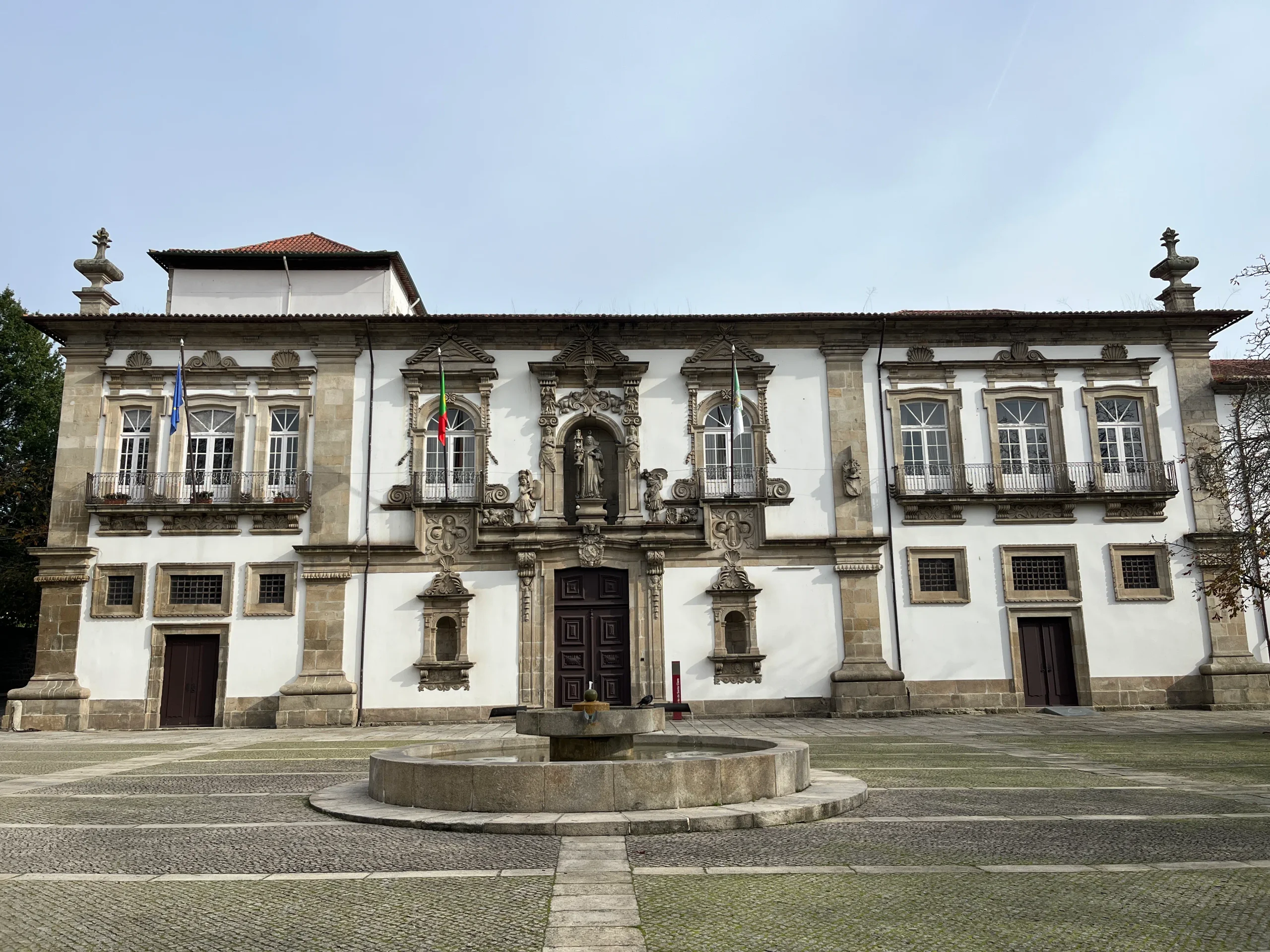
Passing under the arcades of the former town hall, we come to another charming square - Praça de São Tiago. From here it's not far to the city government building, Câmara Municipal de Guimarães, which formerly served as a monastery. The town hall can be visited for free, including the garden and beautiful cloisters.
Câmara Municipal de Guimarães
Jardim do Carmo
We smoothly continue through the old town until we reach the area of more attractions, by the peaceful and very charming Jardim do Carmo. On the left side stretches a row of beautiful white tenement houses with traditional balconies, which fit perfectly into the atmosphere of this place. On the right rises the Igreja de Nossa Senhora do Carmo, a church decorated with a beautiful azulejo panel depicting the Mother of God. Right next to the church is the Santa Estefânia Care Home, a peaceful complex with light-colored walls that gives this corner an even more intimate character.
Azulejo at Nossa Senhora do Carmo church
Santa Estefânia Care Home
Palace of the Dukes of Braganza and Guimarães Castle
The next points that absolutely cannot be missed during a visit to Guimarães are the Palace of the Dukes of Braganza and Guimarães Castle - some of the oldest monuments not only in the city, but in all of Portugal.
The Palace of the Dukes of Braganza (Paço dos Duques de Bragança) is an imposing medieval residence of the first Dukes of Braganza, located in the historic city center, right next to the castle. The building impresses with its austere, castle-like form, large chimneys and spacious courtyard. The palace interiors can be visited - you'll see restored chambers, traditional royal furniture, tapestries, armor and furnishings that transport visitors to the times of medieval Portugal.
Just a few steps further rises Guimarães Castle, widely recognized as the cradle of Portugal. It is with this place that the history of the first Portuguese dynasty and the birth of the state is connected. The castle has a surprisingly complex and not entirely unambiguous history, and its creation is attributed to the charismatic Countess Mumadona, who in the 10th century initiated the construction of the first fortifications. Today you can walk along the walls, climb the towers and admire the city panorama.
Detailed information about opening hours, ticket prices and visiting options can be found on the official website: link to pacodosduques.gov.pt website
In the vicinity of both buildings, in the surrounding park, there is also a tiny chapel of São Miguel do Castelo, known from the legend of the baptism of the first king of Portugal, Afonso I. Slightly lower is another small temple - the Santa Cruz chapel. Going further towards the park, you can see the monastery of Santo António, along with the adjacent chapel.
Courthouse
Tribunal Judicial de Guimarães is an impressive, representative administrative building located at the spacious Largo Condessa da Mumadona square. Its modern, monumental form stands out against the city's historic buildings, creating an interesting contrast with nearby medieval monuments. From the square there is also a view of the Palace of the Dukes of Braganza towering over the city, which further emphasizes the significance of this part of Guimarães.
It is on the square in front of the Courthouse that various public events such as gatherings, demonstrations or strikes often take place - which is why this place is often full of local life and constitutes an important point on the city map.
Wall Tour - Muralhas de Guimarães
Right next to Largo Condessa da Mumadona square begins a fragment of the old defensive walls of Guimarães. This is one of the more interesting attractions of the city, because part of the walls has been made accessible for viewing. A specially designated metal walkway runs along them, allowing you to walk the upper part of the fortifications and see the city from a slightly different perspective.
The walk along the walls is short, but very atmospheric - it allows you to feel the medieval character of Guimarães and see what the city's defense once looked like. The walkway ends near another important point on the city map: Igreja e Oratórios de Nossa Senhora da Consolação, one of the most beautiful churches in Guimarães, with a characteristic facade and garden stretching in front of the temple.
Igreja e Oratórios de Nossa Senhora da Consolação
The Santos Passos Church, also known as Igreja e Oratórios de Nossa Senhora da Consolação, is an 18th-century Baroque Catholic temple, one of the most recognizable points of Guimarães. The church facade is covered with characteristic white and blue azulejos, which give the building a unique Portuguese character.
The building was built on the site of a former chapel that was destroyed, and together with the church in the 18th century, five oratories depicting the Passion of Christ were built. In 1993, the entire complex was inscribed on the list of monuments protected by the Portuguese government, and then in 2001 it was included within the boundaries of the historic center of Guimarães, protected by UNESCO.
The church plays an important role in local religious ceremonies and processions, being one of the key places of worship in the city. Right in front of it stretch three rectangular, carefully maintained gardens full of flowers and trimmed shrubs, whose layout and colors change with the seasons. The green space brings exceptional peace and perfectly complements the monumental facade of the temple. Entrance to the church is free, so it's worth going inside to see the beautiful Baroque interior and feel the atmosphere of a place that has played an important role in the spiritual life of Guimarães residents for centuries.
St. Francis Church and Monastery
On the way back to the station, it's worth stopping at St. Francis Church (Igreja de São Francisco) and the adjacent monastery. The monastery facade alone, covered with mosaics and blue azulejos, stands out from the surrounding buildings and immediately catches the eye.
The interior of the church is definitely worth seeing, because the walls are decorated with extensive azulejo compositions, and the richly gilded altar in Baroque style impresses with details and craftsmanship. Entrance to the church is paid and costs €2.
Cable Car to Penha
Beyond the historic center of Guimarães, full of monuments and atmospheric alleys, it's also worth heading to one of the city's most scenic attractions - Penha hill. You can reach the very top via the cable car Teleférico da Penha, which itself is an interesting attraction and allows you to admire the area from a completely different perspective. The one-way ride takes just under 10 minutes. Cable car operating hours vary depending on the season, so it's best to check them on the official website: url to turipenha.pt.
At the top, not only awaits you a wonderful city panorama (including the Vista Panorâmica de Guimarães viewpoint), but also several interesting places, such as the Santuario de Nossa Senhora do Carmo da Penha, the small Capela de São Cristóvão with a viewing tower, and rides on a local tourist train. It's also a great place for a walk. It's worth immersing yourself in the local forest full of moss-covered huge rocks and wonderful views. You can also drive to Penha by car - parking lots are available at the top, and even a camping ground if someone would like to stay longer.
Where to Eat
Carambola
A very charming and relatively new cafe located right at the entrance to the old town, next to the aforementioned Aqui Nasceu Portugal customs tower. It's the perfect place for your first break while exploring Guimarães. At Carambola you can stop for delicious coffee and fresh Portuguese pastries - pastéis de nata with a hint of orange, soft bolo de Berlim, as well as many other sweet treats prepared on site. The address is: Alameda de São Dâmaso nº 4
Pregaria de Guimarães
If you get hungry while exploring the city, it's worth heading for a traditional Portuguese delicacy - sandwiches with meat, cheese and toppings. We had the opportunity to visit here and can recommend this restaurant with a clear conscience - everything was fresh, aromatic and very filling. The restaurant is located not far from the aforementioned Carambola cafe, so it will work perfectly as another culinary point while sightseeing. The address is: Av. Dom Afonso Henriques 15
Summary
Guimarães is a city that has retained its unique character and still hides a rich history visible at every step - in medieval walls, churches, squares and narrow cobbled streets. It's a real journey to the beginnings of Portugal. In our opinion, it's definitely worth going here even for one day to escape the crowds of tourists in Porto, see a unique old town and immerse yourself for a moment in the exceptional atmosphere of the place where "Portugal was born".
Frequently asked questions
How do I get to Guimarães from Porto?
Take a direct train from São Bento station in Porto - the journey takes about an hour and a one-way ticket costs €3.55. Check the times at cp.pt and buy tickets at the station (machines or ticket office). Remember to validate your ticket in the yellow validator before boarding. The train connects Portugal's second-largest city with the cradle of Portugal - medieval Guimarães.
What are the main attractions in Guimarães UNESCO Old Town?
Start at the customs tower with its 'Aqui Nasceu Portugal' inscription (Portugal was born here). Largo da Oliveira square is home to the Igreja de Nossa Senhora da Oliveira church, the Padrão do Salado Gothic monument from 1340 (commemorating the Battle of Río Salado), the Museu de Alberto Sampaio and picturesque tenements, and through the former town hall arcades you reach Praça de São Tiago square. It's worth visiting Câmara Municipal de Guimarães (a free visit including the garden and cloisters) and Jardim do Carmo, with its traditional white balconies and the Nossa Senhora do Carmo church (with an azulejo panel of the Mother of God). Also see the Muralhas defensive walls with their metal walkway, Igreja e Oratórios Nossa Senhora da Consolação (known as Santos Passos - 18th-century Baroque, white-and-blue azulejos, five Passion oratories, UNESCO 2001, free entry) and St. Francis Church (azulejo compositions, a gilded Baroque altar, €2 entry).
What can I see at the Palace of the Dukes and Guimarães Castle?
The Palace of the Dukes of Braganza (Paço dos Duques de Bragança) is an imposing medieval residence with an austere, castle-like form, large chimneys and a spacious courtyard. Inside you'll find restored chambers, royal furniture, tapestries, armor and medieval furnishings. Guimarães Castle dates from the 10th century and was built by the charismatic Countess Mumadona - the cradle of Portugal and its first dynasty, where you can walk along the walls, climb the towers and take in the city panorama. Nearby stand the São Miguel do Castelo chapel (linked to the legend of King Afonso I's baptism), the Santa Cruz chapel and the Santo António monastery. Prices and hours are at pacodosduques.gov.pt.
How do I visit Penha hill and what's there?
The Teleférico da Penha cable car reaches the top in under 10 minutes. Up there you'll find the Vista Panorâmica de Guimarães viewpoint (a wonderful city panorama), the Santuario de Nossa Senhora do Carmo da Penha, the Capela de São Cristóvão with its viewing tower, tourist train rides and a forest walk among moss-covered huge rocks. You can also drive up - there's parking and camping at the top. Opening hours vary by season, so check turipenha.pt. It's a perfect escape from the historic center into nature and panoramic views.
Where should I eat in Guimarães?
Carambola (Alameda de São Dâmaso nº 4) is a charming café at the old town entrance, next to the Aqui Nasceu Portugal tower. It serves fresh Portuguese pastries - pastéis de nata with a hint of orange, soft bolo de Berlim and other sweet treats prepared on site - along with delicious coffee, making it a perfect first break while exploring. Pregaria de Guimarães (Av. Dom Afonso Henriques 15) serves traditional Portuguese sandwiches with meat, cheese and toppings - fresh, aromatic and filling. It's near Carambola, so it makes a great second culinary stop during sightseeing.
And if you want to stay up to date with more travel inspirations, check out our socials!